
Views: 0 Author: Site Editor Publish Time: 2026-08-20 Origin: Site
For wellness centers, clinics, and gyms, investing in a commercial red light panel goes beyond offering a trendy new modality. It requires balancing high-volume client results alongside stringent liability and compliance standards. Facilities face unique operational challenges. Consumer-grade panels are designed for light, intermittent use. In a commercial setting, panels run for hours on end. This intense usage drastically escalates the requirements for robust thermal management, strict emission controls, and pinpoint dosing accuracy.
Evaluating commercial red light panel safety requires looking far past flashy marketing claims. You must carefully assess verifiable hardware safeguards, mandatory regulatory compliance, and practical operator protocols. This guide explores the critical safety features every facility needs. You will learn how to decode regulatory certifications, understand hardware risks, and implement foolproof operator guidelines to protect your business and your clients.
Regulatory baselines matter: "FDA Registered" is an administrative baseline; "FDA Cleared" (Class II Medical Device) indicates rigorous safety and efficacy testing.
Hardware dictates risk: Commercial panels must feature zero-flicker LEDs, advanced multi-fan cooling, and verified low EMF/ELF emissions to protect both clients and operators.
Dosimetry is a safety feature: Precision control over irradiance and built-in fail-safes (auto-shutoff) prevent accidental overexposure.
Multi-wavelength requires multi-layered safety: Managing near-infrared (NIR) output requires stricter optical safety protocols compared to visible red light.
Safety directly influences your bottom line. Equipment malfunctions or adverse client reactions carry massive financial consequences. A single thermal burn or ocular injury can trigger devastating liability claims. These events instantly spike insurance premiums and damage facility reputations. Investing in clinical-grade safety features functions as an insurance policy. It protects your revenue streams against preventable accidents.
We must also consider the high-volume stress test. A home user might run a device for 15 minutes a day. Commercial environments push equipment to its absolute limits. Clinic devices often run for eight or more hours daily. This relentless constant use demands industrial-grade safety architecture. Cheap plastic components and weak internal cooling fans will fail under commercial stress. They melt, degrade, and become fire hazards.
You can leverage safety as a powerful business asset. It builds exceptional brand trust. High-ticket clientele expect premium, risk-free experiences. Framing your clinical-grade safety protocols as a marketing differentiator elevates your brand. It proves you prioritize client wellbeing over cheap equipment shortcuts.
Risk Mitigation: Premium safety features dramatically lower the chance of client injury and subsequent lawsuits.
Operational Longevity: Commercial-grade thermal management prevents catastrophic hardware failures during peak business hours.
Premium Positioning: Highlighting FDA clearances and low EMF data attracts discerning, health-conscious consumers.
Many buyers fall into a common marketing trap regarding FDA terminology. Understanding the critical distinction between "FDA Registered" and "FDA Cleared" remains vital. Registration represents an administrative baseline. A company simply pays a fee and submits a form to list their facility. It does not guarantee device safety. It does not prove clinical efficacy.
Conversely, FDA Clearance represents a rigorous hurdle. To achieve Class II Medical Device clearance, manufacturers must prove their device is substantially equivalent to a legally marketed predicate device. They submit extensive data ensuring verifiable safety and performance. When protecting your clients, clearance matters significantly more than registration.
International standards also play a role in safety validation. Look for ISO 13485 certification. This standard dictates strict quality management systems for medical device manufacturing. CE Marks indicate compliance with European health, safety, and environmental protection standards. Avoid loosely used "medical-grade" terms. True medical-grade panels provide verifiable documentation backing their clinical safety claims.
| Regulatory Status | Definition & Process | Safety Implication for Clinics |
|---|---|---|
| FDA Registered | Manufacturer paid a fee and submitted a facility listing form. | Low. No clinical data or independent safety testing required. |
| FDA Cleared (Class II) | Proven substantially equivalent to an existing medical device. | High. Verifiable safety, efficacy, and quality control data submitted. |
| ISO 13485 | International standard for medical device quality management. | High. Ensures consistent manufacturing and rigorous quality audits. |
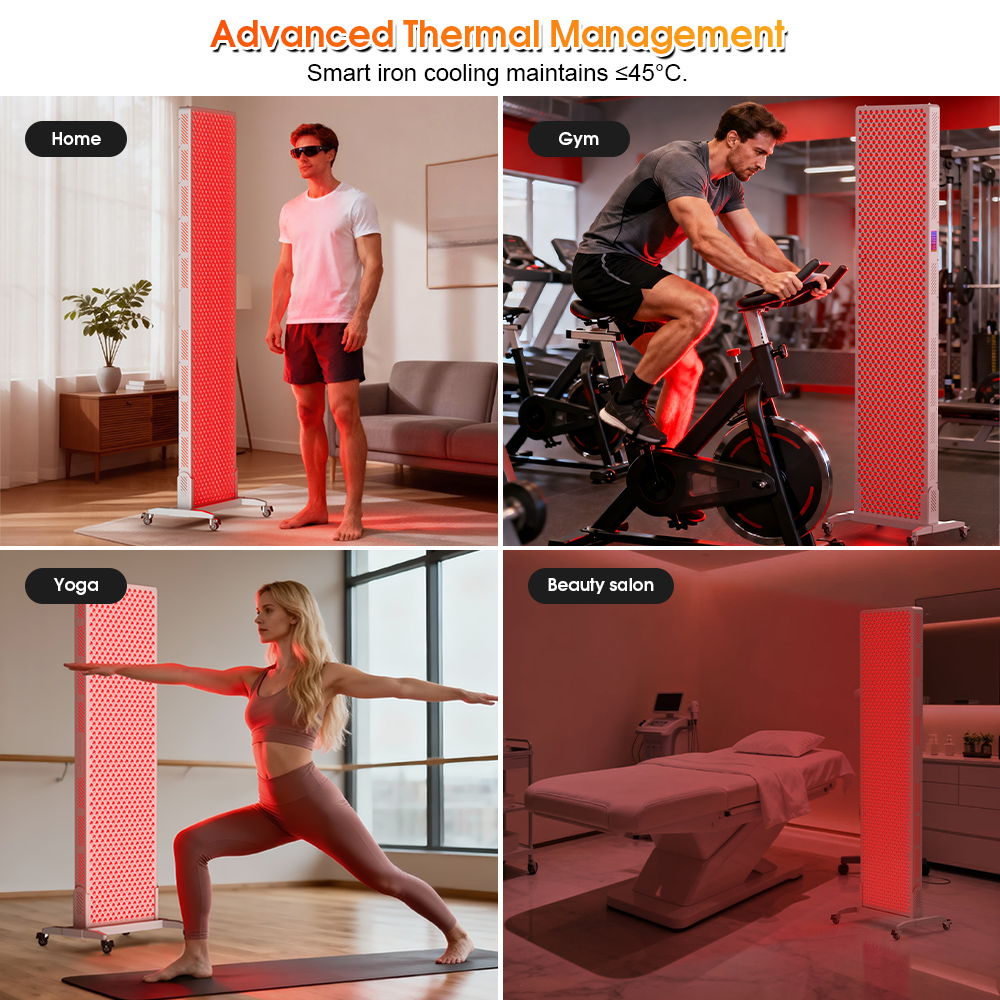
Evaluating the internal engineering of a Multi-Wavelength Therapy Panel separates professional tools from consumer toys. Hardware design directly dictates operator and client safety. Let us examine three non-negotiable physical safeguards.
Electromagnetic Fields (EMF) and Extremely Low Frequency (ELF) radiation surround all electrical devices. Strong EMF exposure contradicts the healing purpose of photobiomodulation. It causes cellular stress. Commercial panels draw massive amounts of power. Without proper engineering, they emit dangerous fields directly into the client's body.
Professional panels utilize specific shielding technologies. They feature fully shielded internal wiring and heavy-duty grounded power supplies. These components suppress electromagnetic noise. You should request third-party testing reports. Ensure the panel registers 0.0µT at the standard treatment distance (usually 6 inches). This protects clients during lengthy or frequent sessions.
Diodes generate significant heat. Overheating presents severe risks in a clinical setting. First, it creates a literal burn hazard if a client touches the acrylic faceplate. Second, heat destroys the therapeutic value of the light. Diodes suffer from "wavelength shift" when they run too hot. A diode meant to emit 660nm might drift to 670nm. This shift pushes the light outside the proven biological absorption window.
Heat also drastically reduces LED lifespan. You must select a Commercial Red Light Panel featuring advanced thermal architecture. Look for multi-point internal cooling fans. Demand thick aluminum heat sinks behind the diode boards. These sinks pull heat away from the faceplate, ensuring stable wavelengths and safe surface temperatures.
Optical safety extends beyond the light spectrum. Cheap LED drivers create an invisible strobe effect called flicker. While the human eye cannot perceive it, the brain certainly processes it. Invisible LED flicker triggers severe neurological strain in sensitive individuals.
Flicker frequently causes migraines, vertigo, or intense nausea. To avoid adverse client reactions, commercial devices require premium, continuous-wave LED drivers. These components supply a perfectly smooth, uninterrupted stream of power to the diodes. Continuous-wave drivers eliminate flicker entirely, providing a soothing and neurologically safe treatment experience.
Safety heavily depends on precise dosing. In photobiomodulation, more power does not equal better results. Exaggerated power claims (often stated in mW/cm²) should act as a massive red flag. Extremely high irradiance without balanced distance guidelines creates severe risks.
When irradiance pushes too high, the energy creates thermal tissue heating rather than photochemical stimulation. This negates the therapeutic effect and risks skin damage. Accurate dosimetry ensures clients receive the exact energy payload required for cellular repair. Manufacturers must provide detailed treatment distance charts to ensure safe application.
Automated failsafes prevent human error. Busy clinic staff can easily become distracted. You need systems stopping treatments automatically. Commercial devices utilize hardwired timers and auto-shutoff mechanisms. Once the prescribed dose finishes, the machine powers down completely. Digital lockouts prevent unauthorized staff from altering dose durations or maximum intensities.
Zoned activation provides another vital safety layer. A professional panel allows operators to independently control specific wavelengths. Sometimes, a client presents contraindications for near-infrared light, but responds well to visible red light. Independent toggles allow you to deactivate the NIR channel entirely, ensuring a customized and perfectly safe session.
Near-infrared (NIR) wavelengths (typically 810nm-850nm) penetrate deeply into tissues. They offer incredible benefits for muscle recovery and joint pain. However, they present unique invisible dangers. Because NIR falls outside the visible spectrum, the human eye does not detect it.
When bright visible light hits our eyes, we naturally squint or blink. This blink reflex protects our retinas. Because NIR is invisible, clients lack this natural protective reflex. Their pupils remain dilated, allowing high-intensity energy to flood the retina undetected. Over time, unrestricted NIR exposure risks ocular damage.
Strict clinical standards deem protective eyewear non-negotiable for specific treatments. High-irradiance facial treatments absolutely require blackout goggles. Do not rely on clients simply closing their eyes. Eyelids do not block deep-penetrating NIR energy effectively.
Provide medical-grade, opaque eye protection for all sessions.
Train staff to place goggles on clients before activating the panel.
Use built-in dimming features to step down intensity. Slowly acclimating clients to high-lumen outputs prevents sudden optical shock.
Hardware features cannot prevent every accident. Facilities must establish rigorous standard operating procedures (SOPs). Proper operator training bridges the gap between machine capabilities and real-world safety. Staff must learn how to assess client suitability before ever turning on a device.
Identifying contraindications acts as your first line of defense. Staff must screen every client thoroughly. You must watch out for specific risk factors. Clients taking photosensitizing medications (like lithium, certain antibiotics, or Accutane) face severe skin reaction risks. Active malignancies require clearance from an oncologist, as increased cellular ATP could theoretically impact cancer cells. Severe ocular conditions also warrant medical clearance.
Sanitation practices tie directly into electrical safety. Spas and gyms feature highly humid environments. Sweat and moisture easily enter poorly sealed devices. Moisture causes electrical shorts and corrosion. Professional units need appropriate IP ratings for moisture resistance. Furthermore, cleaning protocols must not degrade the equipment. Staff need to sanitize panels between high-turnover sessions quickly. The acrylic casing must withstand medical-grade sanitizing wipes without clouding, cracking, or losing structural integrity.
Securing professional-grade equipment requires intense scrutiny. You cannot trust marketing buzzwords when client safety is at stake. Always practice sound shortlisting logic. Before purchasing, demand raw testing data from the manufacturer. Request third-party EMF reports, thermal stress test results, and verified irradiance measurements measured at actual treatment distances.
A true commercial-grade panel serves a trifold purpose. It protects the patient’s biology through precise dosimetry and stable wavelengths. It protects the operator’s safety through automated lockouts and low electrical emissions. Finally, it protects the facility’s liability by preventing burns, ocular damage, and equipment fires.
Take proactive steps today. Compare manufacturer spec sheets rigorously. Look for FDA Clearances over simple registrations. If navigating these technical specifications feels overwhelming, consult with a photobiomodulation implementation specialist to safeguard your investment.
A: Yes, they are generally safe for all skin types. They do not utilize UV light and do not cause tanning or sunburns. However, individual dose adjustments are required. Operators must customize treatment times based on individual skin sensitivity and the use of specific topical medications.
A: Red light treats surface-level tissue and remains highly visible, naturally triggering the blink reflex. NIR penetrates deeper into muscles and joints but is entirely invisible. This invisibility makes strict eye protection protocols and careful thermal monitoring far more critical during high-intensity NIR sessions.
A: Generally no. Most panels are classified as low-risk general wellness devices or Class II exempt devices. However, you must always verify local state board regulations. Specific rules regarding esthetics, massage therapy, and physical therapy vary significantly by jurisdiction.
A: Pregnancy serves as a precautionary contraindication due to a lack of clinical trials. Absolute contraindications include the use of photosensitizing medications (e.g., lithium, specific antibiotics, retinoids) and treating over active cancer lesions unless explicitly directed and monitored by a licensed oncologist.


