
Views: 0 Author: Site Editor Publish Time: 2026-08-14 Origin: Site
The light therapy market offers countless devices today. Buyers often struggle to choose between single-wavelength and dual-wavelength options. You might wonder if a single device can effectively deliver multiple wavelengths simultaneously. Does splitting the optical output dilute the overall therapeutic power? Balancing 660 nm red light and 850 nm near-infrared light inside a compact wearable requires complex engineering. Manufacturers must optimize LED architecture, thermal management, and precise irradiance distribution. Poorly designed units often sacrifice clinical efficacy for user convenience. We will break down exactly how modern manufacturers design these advanced devices. You will discover the common trade-offs involved in dual-wavelength delivery. Finally, we will show you how to evaluate these products to ensure they meet strict clinical success criteria.
Synergistic Depth: 660 nm targets the epidermis and dermis (skin health, surface recovery), while 850 nm penetrates subcutaneous tissue and muscle (deep recovery, inflammation).
LED Architecture Matters: The best devices use dual-chip LEDs or tightly packed alternating diodes to ensure uniform light distribution.
Power Distribution: True dual-wavelength devices do not halve your treatment power; they balance the optical output to maintain a therapeutic irradiance level (typically 30–50 mW/cm² for wearables).
Form Factor Influences Output: Proximity to the skin in wearables (caps, belts, masks) drastically reduces energy loss compared to standalone panels, making lower raw power outputs highly effective.
Engineers face a massive optical challenge when building a dual wavelength red light wearable. They must fit two distinct light wavelengths into a flexible form factor. This device must maintain direct skin contact. It also needs to operate safely without overheating the user. Cramming hundreds of diodes into silicone or fabric creates significant thermal bottlenecks.
Manufacturers typically solve this diode placement challenge in two ways. They use either alternating diodes or dual-chip LEDs. Each approach carries unique engineering trade-offs.
Alternating diodes utilize a checkerboard pattern across the device. One diode emits 660 nm red light. The next diode emits 850 nm near-infrared light. This method remains highly cost-effective for manufacturers. However, it can create uneven dosing if the diode density remains too low. You might experience "hot spots" where one area receives only surface-level red light while an adjacent area receives only deep-tissue infrared light. Proper therapeutic overlap requires a high density of alternating diodes.
Dual-chip LEDs represent the gold standard for premium wearables. Engineers house both a 660 nm emitter and an 850 nm emitter inside a single optical lens. This unified architecture provides highly uniform light dosing. The skin receives both wavelengths at the exact same target point. It eliminates the checkerboard gap effect entirely.
| Feature | Alternating Diodes | Dual-Chip LEDs |
|---|---|---|
| Placement Strategy | Checkerboard pattern across the surface | Both emitters share one physical lens |
| Dosing Uniformity | Moderate (Prone to micro-gaps) | Extremely High (Perfect overlap) |
| Manufacturing Cost | Lower (Budget-friendly models) | Higher (Premium clinically-graded models) |
| Thermal Output | Spread across wider physical space | Concentrated at single lens points |
Thermal management dictates the lifespan and safety of these devices. Flexible silicone and fabric wearables lack the internal cooling fans found in metal panels. When a device runs both 660 nm and 850 nm outputs simultaneously, it generates substantial heat. Premium manufacturers use advanced thermal dissipation layers inside the silicone. These layers pull heat away from the skin barrier. Proper heat management prevents LED degradation. Diodes lose their exact wavelength calibration if they run too hot. Best practices dictate testing your wearable against the skin for ten minutes to ensure the surface remains comfortably warm, never hot.
Modern wearables offer different delivery modes. Users must choose between simultaneous delivery and sequential delivery. Each mode impacts the underlying biology differently.
Simultaneous delivery turns on both wavelengths at once. You receive 660 nm and 850 nm photons at the same time.
Pros: This mode cuts your total treatment time in half. It also capitalizes on the biological "entourage effect." The 660 nm light stimulates superficial blood flow and dilates local capillaries. This localized surface vasodilation may enhance the delivery of systemic benefits triggered by the deeper penetrating 850 nm light. Active blood flow helps transport the anti-inflammatory cellular signals deeper into the muscle tissue.
Cons: Running both chips simultaneously requires a robust power source. It demands a higher quality battery. It also requires superior heat dissipation materials to keep the skin safe.
Sequential delivery allows you to switch modes. You run the 660 nm light for a set time. Then you switch to the 850 nm light.
Pros: This method routes maximum battery power to a single wavelength. It proves ideal for highly targeted, single-depth issues. If you only want to treat surface-level oxidative stress, you can blast the skin using purely 660 nm energy. It preserves battery life efficiently.
Cons: Sequential delivery doubles the required treatment time if you want the benefits of both wavelengths. Compliance often drops when sessions take thirty minutes instead of fifteen.
Simultaneous output generally serves as the preferred evaluation verdict for daily users. It maximizes convenience. It drives higher routine compliance. You will likely see better long-term results simply because you actually finish the sessions. However, the device must maintain verified irradiance levels while running both chips.
Many buyers face the "half-power" myth during the research phase. Skeptics claim a dual-wavelength device only delivers fifty percent of the required power per wavelength. They assume splitting the battery output inherently dilutes the treatment. This fundamental misunderstanding of optical physics misleads many consumers.
Proximity compensation plays the most crucial role here. The inverse-square law of light dictates how photons travel. Light intensity drops exponentially as distance increases. A powerful standalone metal panel might output 100 mW/cm². However, you usually stand six to twelve inches away from it. The ambient air scatters a massive percentage of those photons. They reflect off the room and bounce away from your body.
A wearable device sits directly on your skin. This represents a zero-centimeter distance. Skin contact minimizes optical reflection. The photons have nowhere else to go but directly into your cellular tissue. Therefore, a wearable outputting a modest 30 mW/cm² can easily deliver the exact same net joules to the tissue as a 100 mW/cm² panel sitting six inches away. The lower raw power output works perfectly because efficiency reaches maximum levels.
You must learn how to measure true output. Common mistakes include looking only at raw consumptive wattage. Consumptive wattage only measures the power the battery drains. It does not measure the actual light the diodes produce. Inefficient diodes burn high wattage but produce mostly heat instead of therapeutic photons. Buyers should always look for independent third-party radiometric testing. These laboratory reports measure actual milliwatts per square centimeter delivered to the target zone. True irradiance reports separate premium clinical devices from cheap novelty electronics.
Different body parts require specific form factors. The underlying biology changes depending on where you place the wearable. Manufacturers tailor the 660 nm and 850 nm balance based on the target zone.
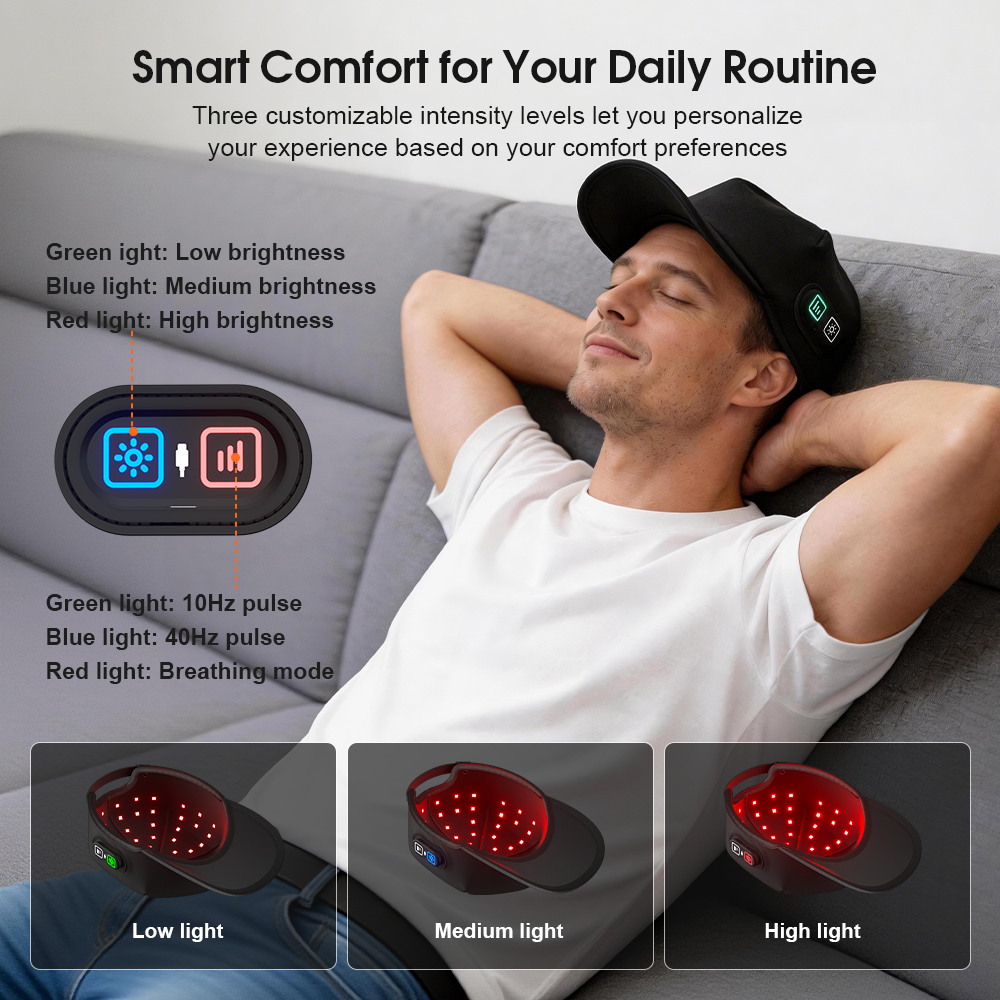
A specialized Dual-Wavelength Therapy Cap addresses unique biological hurdles. Hair creates a dense physical barrier. Standard light scatters when it hits hair strands. The 660 nm red light primarily supports surface follicle health. It increases microcirculation in the scalp dermis. This brings oxygen and vital nutrients directly to struggling hair follicles.
The 850 nm near-infrared light performs a different task entirely. It bypasses the surface and penetrates deeper into the scalp tissue. It reduces deep scalp inflammation. Chronic microscopic inflammation often triggers follicle miniaturization. You need high-density LED placement inside these caps. A sparse diode layout will simply light up the hair. Dense placement ensures photons reach the actual scalp skin.
Wearable belts and wraps focus heavily on physical recovery. The 850 nm wavelength acts as the heavy lifter here. It easily penetrates the skin barrier. It reaches deep subcutaneous tissue, joint capsules, and inflamed muscle bellies. Deep tissue stimulation encourages cellular ATP production and clears inflammatory markers from fatigued muscles.
Meanwhile, the 660 nm wavelength handles surface-level oxidative stress. It speeds up the healing of superficial fascia and skin abrasions. The simultaneous delivery proves vital for athletes. You calm deep joint pain while simultaneously repairing surface tissue damage.
Facial wearables require a very delicate optical balance. Delivering 850 nm light safely near the eyes demands precision engineering. Unfiltered near-infrared light can cause thermal stress to retinal tissue over long periods. Premium masks utilize deep protective silicon eye inserts to block stray photons. They maximize the 660 nm red light across the cheeks and forehead to stimulate natural collagen production. The dual-wavelength approach improves skin elasticity while reducing underlying facial tension.
You need a concrete framework to evaluate a modern Red Light Therapy Wearable. Visual aesthetics rarely tell the whole story. You must dig into the engineering specifications.
Wavelength Precision: Do not assume a red light is automatically 660 nm. Cheap diodes fluctuate wildly. You must look for a verified variance of +/- 5 nm. This ensures the 660 nm light does not drift down to 640 nm. If the wavelength drifts, it misses the optimal absorption peak of your cellular mitochondria.
Pulsed vs. Continuous Wave (CW): Continuous wave delivers a steady stream of photons. It works perfectly for standard dosing. However, some advanced devices offer pulsed light. They might pulse the diodes at 10Hz or 40Hz. Pulsed light allows the tissue to cool for fractions of a second. This mechanism potentially drives photons deeper for neurological or deep tissue benefits. Clarify if using the pulsed mode impacts your total therapeutic dose. You usually need to wear a pulsed device slightly longer to achieve the same joule delivery.
Safety and Compliance:
Check for 0.0 µT (microteslas) EMF emissions at contact distance. You do not want electromagnetic fields passing into your body.
Look for FDA Class II medical device clearance or equivalent regulatory validation. This proves the company submitted their electrical safety data to a regulatory body.
Ensure the device uses flicker-free optical drivers. Invisible micro-flickering strains the nervous system. It can cause severe headaches and nausea during treatment.
Battery Lifecycle: Dual-wavelength operation drains batteries significantly faster than single-wavelength devices. Running two sets of optical chips requires immense stable power. The minimum acceptable standard is a 3000+ mAh capacity battery. Anything smaller will suffer voltage drops. As voltage drops, the light intensity dims. A robust battery ensures consistent irradiance output over the entire lifespan of the session.
A well-engineered dual-wavelength wearable does not compromise on overall power. It leverages direct skin-contact physics to deliver therapeutic doses highly efficiently. Splitting the output between 660 nm and 850 nm provides superior full-depth recovery. The zero-centimeter distance eliminates reflection loss entirely. You get the exact required joules without needing massive wattage.
Your next steps require strict buyer diligence. Urge the manufacturer to reveal their diode layout. Identify if they use dual-chip technology or basic alternating diodes. Demand to see third-party radiometric irradiance reports before purchasing. Never accept raw consumptive battery wattage as a metric for light therapy power. Protect your investment by verifying EMF levels and battery capacity. Choosing the right device ensures you maximize cellular recovery efficiently.
A: Neither is "better"; they serve different biological targets. 660 nm is highly absorbed by skin tissue, making it ideal for collagen production and surface healing. Meanwhile, 850 nm bypasses the skin to reach deeper tissues like muscle, joints, and bone. They work best synergistically.
A: While 850 nm is invisible, it is powerful. For face masks, eye-protection inserts are mandatory to prevent thermal stress on the retina. For therapy caps and bodily belts, ambient exposure is generally safe, but staring directly at the active diodes should always be avoided.
A: Yes. Devices operating in simultaneous mode will require more frequent charging. Powering two distinct diode sets consumes significantly more energy. This is exactly why evaluating the total battery capacity (mAh) of a dual-wavelength device remains critical for consistent, long-term daily use.


