
Views: 0 Author: Site Editor Publish Time: 2026-08-31 Origin: Site
The wellness market is currently flooded with generic white-labeled products. Building a truly defensible brand requires strict engineering and verifiable clinical specifications. Unfortunately, many companies issue vague manufacturing requests. This often leads to underpowered products, frustrating regulatory delays, and unexpectedly high return rates. Customers expect real physiological results. Generic light panels simply cannot deliver them consistently.
You need a clear technical and commercial blueprint to succeed. We will show you exactly how to specify and source an OEM red light therapy device. This guide explains how to select the right form factor, mandate optical precision, and navigate complex regulations. By the end, you will know how to ensure your final product meets essential clinical claims while maintaining strict commercial compliance.
Define Optical Precision: Efficacy relies on exact wavelengths (e.g., 660nm/850nm) and verifiable irradiance (mW/cm²), not just raw LED wattage.
Prioritize Thermal & Electrical Safety: Non-negotiable specs include flicker-free drivers, low EMF emissions, and advanced thermal management to prevent LED degradation.
Align Form Factor with Compliance: Whether designing a targeted wearable LED therapy device or a full-body panel, the form factor dictates specific FDA/CE regulatory pathways.
Demand Manufacturing Transparency: Require ISO 13485 certification, third-party spectrometer testing, and clear IP/mold ownership terms before signing an OEM agreement.
Before contacting any manufacturer, you must define the exact product architecture. A vague concept guarantees a disjointed manufacturing process. Clear architecture aligns your clinical goals directly to engineering realities.
First, identify the primary application. Distinguish clearly between targeted home-use cosmetics, systemic athletic recovery, and clinical-grade professional panels. Home-use devices usually require lower power output and prioritize user comfort. Athletic recovery tools demand higher irradiance for deep tissue penetration. Clinical-grade panels require maximum power, absolute precision, and robust continuous operation capabilities.
Your chosen form factor dictates the entire bill of materials. You must specify exact physical requirements based on the product category.
Rigid Panels: These devices require distinct structural specifications. You must require specifications for daisy-chaining multiple units safely. Specify heavy-duty stand stability to prevent tipping hazards. You also need high-output cooling fans to manage internal ambient temperatures.
Flexible Wearables: If you are designing a targeted Wearable LED Therapy Device, like a belt, mask, or pad, the engineering changes entirely. Require strict specifications for flexible PCB durability. Standard rigid boards will snap during regular use. Specify battery safety protocols, including mandatory UL certification. Finally, insist on biocompatible medical-grade silicone materials to prevent adverse skin reactions.
The interface shapes the entire user experience. Do not settle for simple on/off switches. Specify digital timing features for exact session control. Offer pulsed versus continuous wave options to support diverse clinical protocols. Finally, require wavelength isolation. Users must be able to select red-only, near-infrared (NIR)-only, or combined light outputs easily.
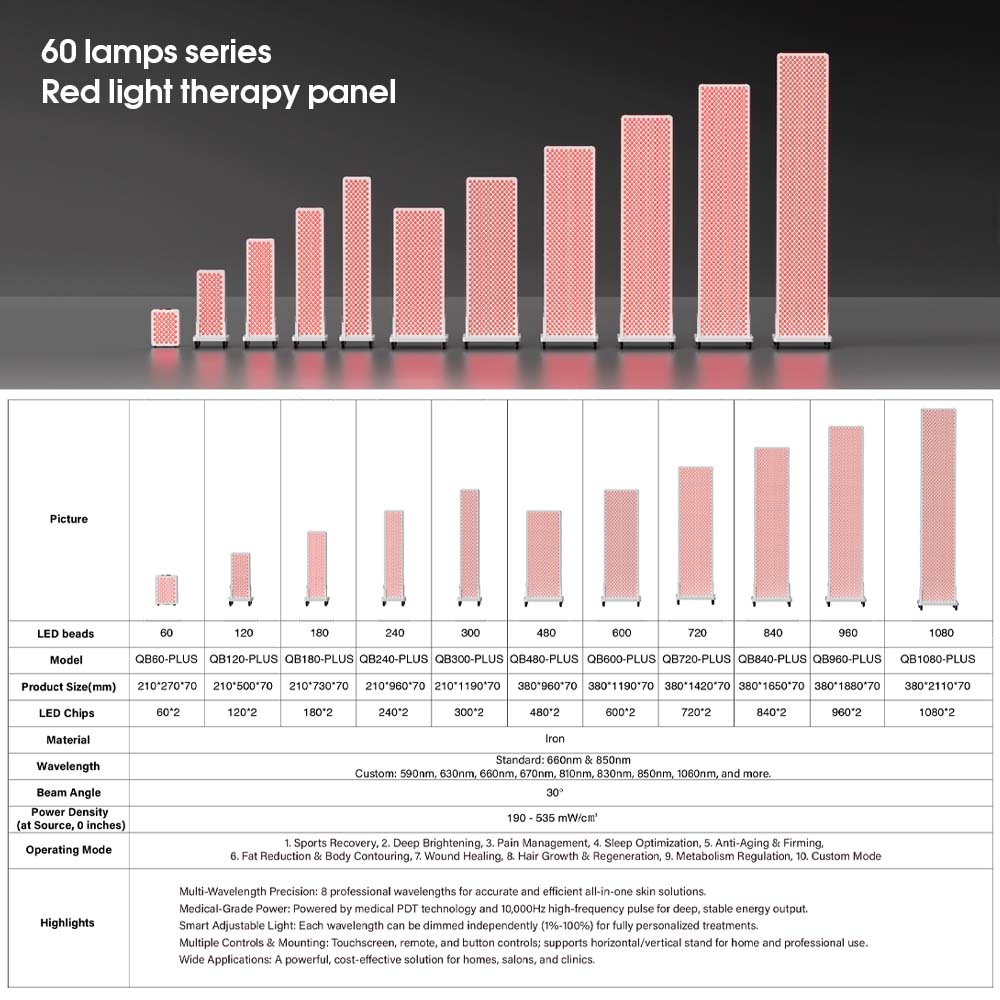
Optical precision determines whether your device actually works. You cannot leave optical parameters open to interpretation. Manufacturers often cut costs here if you do not define strict boundaries.
Never accept broad wavelength ranges from a supplier. Clinical efficacy depends heavily on exact nanometer targeting. Specify exact nanometer outputs in your agreements. Common effective wavelengths include 630nm, 660nm, 810nm, and 850nm. Furthermore, mandate a strict tolerance variance of ± 5nm. A diode marketed as 660nm dropping to 640nm loses its targeted therapeutic value.
Manufacturers frequently use "consumed wattage" to market their devices. This metric is deeply deceptive. A 1000W panel might deliver very little therapeutic light if the components are inefficient. Frame your requirement exclusively around delivered irradiance at specific clinical distances.
For example, specify a requirement of >100 mW/cm² at 6 inches from the light source. This guarantees the user receives enough photonic energy to stimulate cellular response.
The secondary lens focuses the light energy. Without a proper lens, light disperses harmlessly across the room. Specify 30-degree or 60-degree secondary lenses. A 30-degree lens pushes light deeper into muscle tissue. A 60-degree lens offers wider surface coverage for skin treatments. This specification ensures optimal light penetration rather than superficial surface dispersion.
Trust but verify. Factory marketing claims often exaggerate actual spectral output. Mandate independent spectrometer reports before accepting any prototypes. Require integrating sphere test data to validate all wavelength and irradiance claims. If a factory refuses third-party verification, they are likely hiding underperforming diodes.
Safety and longevity separate professional brands from cheap consumer electronics. You must dictate strict electrical and thermal rules.
Electromagnetic Fields (EMF) cause significant concern among wellness consumers. Standard electronics emit high EMF levels. Specify a strict requirement for zero to near-zero EMF emissions at the standard treatment distance. Six inches is a common benchmark for this test. High EMF readings will instantly alienate educated consumers.
Cheap LED drivers pulse the light rapidly. The human eye might not notice this optical flicker immediately, but the brain processes it. This invisible strobing causes severe user eye strain and neurological fatigue. Require high-quality, constant-current LED drivers. They eliminate optical flicker entirely, ensuring a smooth, safe user experience.
Heat degrades LEDs rapidly. A poorly cooled device loses irradiance output after just a few months. Specify extruded aluminum heat sinks for maximum thermal dissipation. Pair these sinks with quiet, high-efficiency magnetic levitation fans.
Outline acceptable operating temperature thresholds directly in your contract. The internal junction temperature must remain low. Proper thermal management guarantees the standard 50,000+ hour lifespan expected from premium devices.
Regulatory hurdles can destroy a product launch. You must build compliance into your specifications from day one.
You must differentiate between general consumer goods and true therapeutic tools. Basic factories hold ISO 9001 certifications. This is insufficient for medical wellness devices. Require the manufacturer to hold ISO 13485 certification. This specific standard governs Medical Device Quality Management Systems (QMS). It ensures traceability and rigorous defect management.
Your target market dictates your necessary certifications. Specify these requirements clearly before production begins.
US Market: Specify strict adherence to FDA Class II 510(k) standards. Require explicit Good Manufacturing Practice (GMP) compliance. Ensure the manufacturer has current FDA facility registration.
EU Market: Specify CE Medical Device Regulation (MDR) readiness. You also must mandate RoHS compliance to verify the absence of hazardous materials like lead and mercury.
Do not assume the factory will test every unit thoroughly. Outline specific expectations for aging tests. Require a 48-hour continuous burn-in test for every device before packaging. Specify electrical safety testing, including mandatory Hipot testing, to prevent electrical shocks. Finally, define a strict batch defect tolerance. A high-end brand should accept no more than a 1% defect rate.
Deciding how to customize your product impacts both budget and timeline. You must choose between utilizing existing designs or creating something entirely proprietary.
Customization Comparison Matrix
| Model Strategy | Speed to Market | Initial Investment | IP Protection Level | Typical Application |
|---|---|---|---|---|
| White-Label | Fast (3-4 weeks) | Low (Minimal setup) | None (Shared design) | Testing new markets quickly |
| Private Mold OEM | Slow (3-6 months) | High (Tooling costs) | High (Exclusive ownership) | Building a defensible brand |
White-labeling is best for rapid market entry. You leverage an existing chassis and internal layout. Specify exact logo placement techniques, such as laser engraving or silk screening. Require custom packaging designs and manual localization for your specific region. Always assess the supplier's Minimum Order Quantity (MOQ). White-label MOQs usually sit comfortably between 100 and 300 units.
A completely custom OEM Red Light Therapy Device is necessary for unique form factors. If you have proprietary tech integrations, you must use a private mold.
Specify exact tooling costs upfront to avoid hidden fees later. Demand a firm timeline for prototyping. Use CNC machining or 3D printing for rapid physical reviews before committing to steel molds. Detail the exact limits and costs for mold modifications during the prototyping phase.
IP Protection: This is a critical vulnerability. Mandate robust Non-Disclosure Agreements (NDAs) before sharing schematics. Establish clear contractual ownership of the final physical mold and all custom PCB designs. You must retain the right to move the mold to another facility if the partnership sours.
Finding a trustworthy factory requires diligent investigation. Superficial vetting leads to catastrophic quality failures.
Look deeply beyond polished Alibaba profiles. Many online listings belong to trading companies, not actual manufacturers. Request live video audits of the assembly line during working hours. Ask to see their internal testing laboratories. A mature factory will gladly show you their integrating spheres, aging racks, and Hipot testing stations.
A manufacturer is only as strong as their supply chain. Assess their reliance on secondary suppliers for critical components. Ask where they source their LEDs. Brands specifying top-tier chips like Epistar or proprietary dual-chip LEDs suffer fewer field failures. Ensure they maintain safety stock of vital components to prevent production delays during peak seasons.
Hardware fails eventually. Your agreement must dictate what happens next. Specify a minimum 2-3 year warranty on all internal parts. Define the exact protocol for handling defective units. Decide whether the factory will ship replacement parts for local repairs or provide full unit swaps. Clear after-sales support terms protect your bottom line from unexpected refund requests.
Sourcing reliable red light therapy hardware requires moving past superficial metrics. Total LED count means nothing if the underlying engineering is flawed. You must enforce strict clinical, optical, and regulatory standards to protect your users and your brand reputation. Focus heavily on irradiance, thermal management, and compliance verification.
Your next step is to compile these exact specifications into a formal Request for Quotation (RFQ) or Request for Proposal (RFP). Send this structured document to potential suppliers. A detailed RFQ will immediately filter out low-tier consumer electronics assemblers. This structured approach helps you identify true medical-grade manufacturing partners capable of scaling your vision.
A: Realistic B2B minimum order quantities vary based on customization depth. For standard white-label modifications like custom logos and packaging, expect an MOQ of 100 to 500 units. If you require private molds and custom tooling, factories typically demand MOQs exceeding 1000 units to justify the engineering effort.
A: No. Standard lighting factories lack the necessary medical expertise. Wearable devices require specialized medical-grade flexible PCB manufacturing. The circuits must withstand constant bending without breaking. Furthermore, manufacturers must source specific biocompatible silicone materials to prevent allergic skin reactions during prolonged direct body contact.
A: No, it does not. The brand or importer typically needs their own FDA registration and specific clearance to sell legally. However, using a 510(k)-cleared predicate device manufactured by a registered OEM drastically simplifies and accelerates your own regulatory application process.
A: Never rely on cheap handheld solar meters. They cannot measure specific narrow-band LED outputs accurately. You must request independent testing data. Require reports generated by lab-grade integrating spheres or advanced spectrometers. These tools verify exact nanometer output and true delivered irradiance across the treatment area.


