
Views: 0 Author: Site Editor Publish Time: 2026-08-09 Origin: Site
The reality of facial skin treatments is simple. Clinical results require cumulative, consistent use. You typically need 10 to 20 minutes daily or several times a week to see noticeable changes. However, many people abandon these routines quickly. Poor ergonomics, intense pressure points, or sensory discomfort lead directly to device abandonment. You stop using the equipment, effectively rendering the entire investment useless. We often focus purely on light wavelengths, energy output, and diode counts. Yet, physical wearability matters just as much for your ultimate success. This article provides a skeptical, evaluation-driven framework. We will help you assess LED therapy mask comfort before you make a high-ticket purchase. You will learn how material choices, strap mechanics, and battery placements impact your daily routine. By the end, you will know exactly what physical features support long-term adherence.
Consistency drives efficacy; discomfort is the primary cause of device abandonment.
Flexible medical-grade silicone offers better contouring than rigid hard-shell masks, but requires specific structural support to protect internal wiring.
Proper weight distribution (removing pressure from the nose bridge) and secure strap mechanics are non-negotiable for session compliance.
Integrated eye protection is essential for sensory comfort and preventing glare-induced headaches, though it limits multi-tasking.
Battery placement determines mobility; true wireless adds weight to the mask, while tethered controllers shift weight to the pocket.
Dermatologists and estheticians agree on one core principle regarding photobiomodulation. Efficacy relies entirely on user adherence over an extended period, usually 4 to 12 weeks. We call this achieving the "cumulative dose." Light therapy works by gradually stimulating cellular energy production. A single session does very little. You must compound the effects through regular exposure. If you fail to wear your device, your skin receives no benefit.
Many users enthusiastically purchase a high-end device, only to face harsh implementation realities. An uncomfortable unit creates immediate friction in your daily routine. If a mask causes deep facial indentations, triggers claustrophobia, or induces tension headaches, it will eventually sit in a drawer. Human psychology dictates we avoid painful or tedious experiences. Comfort directly dictates compliance.
Common Mistake: Buyers often prioritize the highest number of LED bulbs over the physical fit. A heavy unit with 300 bulbs you refuse to wear is infinitely less effective than a comfortable 100-bulb unit you use diligently every single day.
You should frame comfort not as a luxury feature, but as a critical variable in calculating the actual return on investment. If you buy a $400 device and abandon it after 10 uses due to strap pain, your cost-per-use is $40. If you buy a highly comfortable unit and use it 400 times over two years, your cost-per-use drops to $1. Evaluating the ergonomics guarantees you extract maximum value from your skincare investment.
When selecting any LED Light Therapy Mask, you will immediately face a choice between two dominant materials. Manufacturers use either rigid plastic shells or flexible silicone mats. Each approach fundamentally changes the user experience.
Rigid masks utilize thick, molded plastics like polycarbonate or ABS. They maintain a fixed shape regardless of who wears them.
Pros: This design creates a consistent distance between the LED diodes and your skin. This spacing benefits users who dislike direct physical contact or sweat heavily. The rigid outer shell also provides superior durability against accidental drops.
Cons: Standardized molds rarely fit all face shapes. Human bone structure varies wildly. A rigid mask prone to resting directly on a prominent forehead or a sharp jawline will create severe, localized pressure points. These pressure points become highly painful around the 10-minute mark.
Flexible masks dominate the modern premium market. They utilize layers of pliable silicone to wrap around the face.
Pros: They contour closely to your unique bone structure. This wrap-around effect optimizes light delivery by keeping diodes flush against the skin. It accommodates varying face widths easily.
Cons & Skeptical Assessment: We must clarify a critical truth. "Flexible" does not mean indestructible. Inside that silicone sits a delicate Printed Circuit Board (PCB) system connecting dozens of micro-LEDs. Over-bending the mask—especially folding it sharply to stuff it into a bag—can permanently snap these internal copper connections. Dead diodes are a direct result of abusive handling.
Best Practice: Look for devices utilizing thick, medical-grade silicone. This specific thickness balances the necessary flexibility for facial contouring with enough structural integrity to prevent destructive over-bending.
| Feature Category | Rigid Hard-Shell Masks | Flexible Silicone Masks |
|---|---|---|
| Fit Adaptability | Poor. Fixed mold fits only specific facial proportions. | Excellent. Wraps around various bone structures. |
| Durability | High. Resists drops and rough handling. | Moderate. Vulnerable to internal wiring stress if folded sharply. |
| Skin Contact | Hovers slightly above the skin. | Sits flush against the skin. |
| Storage Profile | Bulky. Requires a dedicated, large storage space. | Slim. Can be stored flat in a shallow drawer. |
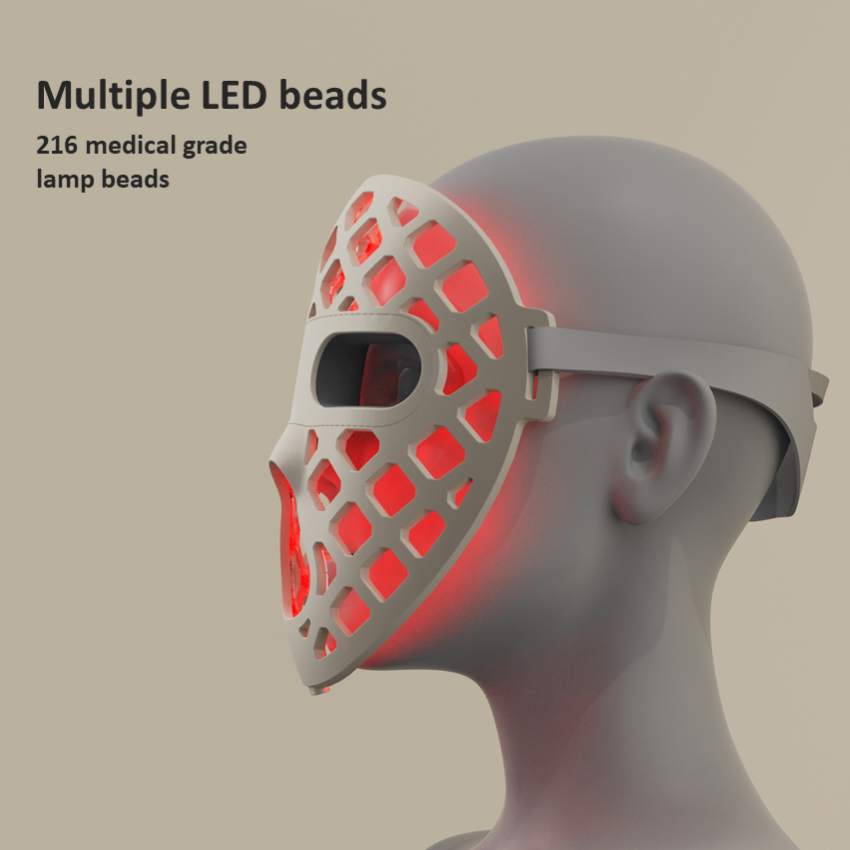
The physical weight of the hardware plays a massive role in how you perceive the session length. Even a few hundred grams feel punishing if improperly balanced.
The nose bridge serves as the most common failure point for ergonomic design. Your nose cartilage is highly sensitive to sustained pressure. If a mask constantly slides downward, gravity forces the entire weight of the device onto the bridge of your nose. After 15 minutes, this pressure restricts breathing and causes lingering red marks. The mask's weight must remain suspended. It should anchor primarily across your forehead and the crown of your head.
Strap mechanics dictate whether you can move around or if you are forced to remain perfectly still. We can categorize strap designs into two main groups:
Single-strap designs: These utilize one horizontal band wrapping around the back of the head. They are notoriously prone to sliding down the face. The single vector of tension pulls the mask tight against the eyes but fails to lift it. This design typically forces the user to lie flat on their back to keep the unit stable.
Dual/Multi-strap designs: These provide a secondary strap passing over the top of the head. This "halo" configuration distributes weight across the crown. It physically lifts the device off the nose bridge. It provides a secure fit. You can walk around, sit upright, or do light chores without constant readjustment.
You must evaluate the materials used for the closure system. Many brands utilize basic hook-and-loop fasteners (Velcro). While easy to adjust initially, cheap Velcro degrades rapidly with daily use. It also catches painfully on long hair. Alternatively, look for wide elastic bands utilizing adjustable slide-buckles. These maintain their tension longer and glide smoothly over hair.
Sensory comfort extends beyond physical touch. It includes how your eyes and lungs process the environment while locked inside the hardware for 20 minutes.
Red light (typically 633nm) and near-infrared light (830nm) wavelengths are intense. While industry-standard devices pass rigorous safety testing, prolonged exposure without physical baffling causes intense user discomfort. Staring into scattered, bright red LEDs triggers light sensitivity. Many users develop headaches simply from the visual strain of the glare. Protecting your vision is paramount for sensory comfort.
Manufacturers tackle the glare problem in a few distinct ways.
Opaque Silicone Goggles/Rings: The most comfortable units feature built-in, opaque silicone eye cups. These rings form a physical barrier against the skin, blocking light bleed from entering your direct line of sight. They allow users to comfortably keep their eyes open, read a book, or scroll on a phone.
Open Designs: Some masks feature basic cutouts for the eyes without internal physical barriers. Light violently scatters into the visual field. This open design often requires you to keep your eyes firmly closed to avoid the glare. It effectively mandates a meditative, stationary session rather than active multi-tasking.
Adequate ventilation matters immensely. Quality LEDs do not emit significant thermal heat. However, wrapping your face in non-porous silicone traps your natural body heat and exhaled breath. If the mask lacks proper ventilation around the nose and mouth, condensation builds up quickly. This trapped moisture creates an uncomfortable, sweltering environment. It triggers claustrophobia for many users. Ensure your chosen device features large, unobstructed breathing ports.
How a brand manages power delivery determines your physical freedom during the treatment. The placement of the lithium-ion battery drastically alters the wearability of your Facial Phototherapy Device.
You must evaluate the trade-offs of battery integration based on your personal habits.
True Wireless (Battery on Mask):
Pro: You experience complete freedom of movement. There are no cords to catch on cabinet handles or wrap around your neck. You can seamlessly walk from room to room.
Con: Batteries are dense and heavy. Integrating the battery directly onto the forehead or chin adds significant physical weight to the facial unit. This extra mass exacerbates slippage. It puts more demand on the strap system to keep the mask suspended.
Tethered Controllers (Battery in Pocket):
Pro: Moving the battery into an external remote control keeps the mask itself incredibly lightweight. You only wear the silicone and the micro-LEDs on your face. This maximizes physical comfort.
Con: You must manage a cord connecting the mask to the remote. You must have a pocket to hold the controller if you wish to stand up. Furthermore, the cord connection point at the mask is a structural weak spot. It can degrade or snap if you repeatedly pull or trip over it.
You need a concrete decision framework to narrow down your options. Base your choice strictly on realistic human behavior, not idealized routines.
Ask yourself when you realistically intend to perform your skincare routine. If you plan to lie quietly in bed while listening to a podcast before sleep, a heavier, corded mask with an open-eye design may perfectly suffice. You do not need mobility.
However, if you are a busy parent who needs to load the dishwasher or fold laundry during your session, your requirements change drastically. You strictly require a lightweight, multi-strap silicone mask. You need built-in silicone eye cups to block glare. You need a pocket controller to keep the weight off your face while you move. Buy the hardware that seamlessly fits the life you actually live.
Treat comfort as a fully testable feature. You cannot truly know how a mask interacts with your unique bone structure until you wear it. Pressure points on the cheekbones or nose often aren't apparent during a quick two-minute try-on. The aches usually appear after the third or fourth continuous 15-minute session.
Therefore, a minimum 30-day return window is mandatory. If the brand does not allow returns on opened devices, look elsewhere. You must have the ability to stress-test the strap mechanics and breathability in your own home risk-free.
Evaluating an LED mask goes far beyond checking wavelength specifications and FDA clearances. The actual physical hardware must actively support realistic human behavior. If a mask pinches your nose, blinds you with glare, or traps hot breath against your skin, you will simply stop using it. Efficacy dies the moment the device hits the bottom of your bathroom drawer.
As your next step, evaluate your top two or three device choices specifically through the lens of ergonomics. Scrutinize the strap design. Confirm the exact weight. Verify how they handle eye protection. By prioritizing wearability alongside technical performance, you guarantee the consistency required to achieve genuine, lasting results for your skin.
A: Yes, but it heavily depends on the mask's specific eye protection design. Devices featuring integrated opaque silicone eye cups block internal light glare, allowing you to focus on screens safely. Open-eye designs without physical baffling cause significant glare, making reading difficult and potentially causing tension headaches. Set realistic expectations based on the hardware.
A: High-quality cosmetic LEDs emit minimal thermal heat. The bulbs themselves do not burn the skin. However, tightly wrapping a non-porous silicone mat around your face traps your natural body heat and exhaled breath. If the mask lacks proper ventilation around the nose, this trapped heat causes sweating. Good ventilation is crucial.
A: Never submerge your device in water. The internal printed circuit boards are delicate. After a session, gently wipe the skin-facing silicone surface using a soft cloth dampened with 70% isopropyl alcohol or a gentle water-based wipe. Avoid harsh folding or scrubbing. Allow the mask to air dry completely before storing it flat.


