
Views: 0 Author: Site Editor Publish Time: 2026-08-06 Origin: Site
A recurring question is surfacing in fitness and wellness communities:
*"I sit for ten hours a day. My lower back and waist feel stiff by 3 PM. I’ve read about red light therapy, but the clinic panels are huge and the masks only cover my face. Is there actually a practical way to target my back, abs, or hips at home?"*
**The Hesitation:** This frustration is understandable. For individuals managing the physical toll of desk work, post-workout soreness, or simply seeking full-body wellness support, the gap between "clinical light therapy" and "real-life usability" is a legitimate deal-breaker. If professional-grade panels require you to lie motionless for twenty minutes, and face masks ignore everything below the neck, how do you integrate light therapy into a busy routine?
**The Core Conflict:** Consumers want the documented benefits of red and near-infrared light exposure for the torso and waist, but need a hands-free, wearable format that moves with them—not against them.
---
## The Science – Why Wavelength and Delivery Method Matter
To resolve this, we must distinguish between wavelength penetration and device format.
### Red vs. Near-Infrared: Complementary Depths
According to photobiomodulation literature and optical engineering principles:
- **Red Light (660nm):** Primarily absorbed by superficial tissue layers, supporting skin-level appearance and surface circulation.
- **Near-Infrared Light (850nm):** Penetrates deeper into subcutaneous tissue and muscle layers, reaching areas that surface-level light cannot.
**The Mechanism:** The combination of 660nm and 850nm wavelengths creates a dual-action profile. The red component supports surface-level tone and texture appearance, while the near-infrared component reaches deeper into the tissue structure of the back, waist, and abdomen—precisely where belt-based application delivers the most value.
### The Wearable Advantage: Surface Area + Contact
The critical question: Does strapping light to your body actually work?
**The Contact-Consistency Principle**
Unlike panel systems that require precise positioning at a fixed distance, a flexible belt maintains consistent proximity across curved anatomy (the lumbar spine, obliques, lower abdomen). This eliminates the "hot spot / cold spot" problem common with rigid devices.
**The Coverage Factor**
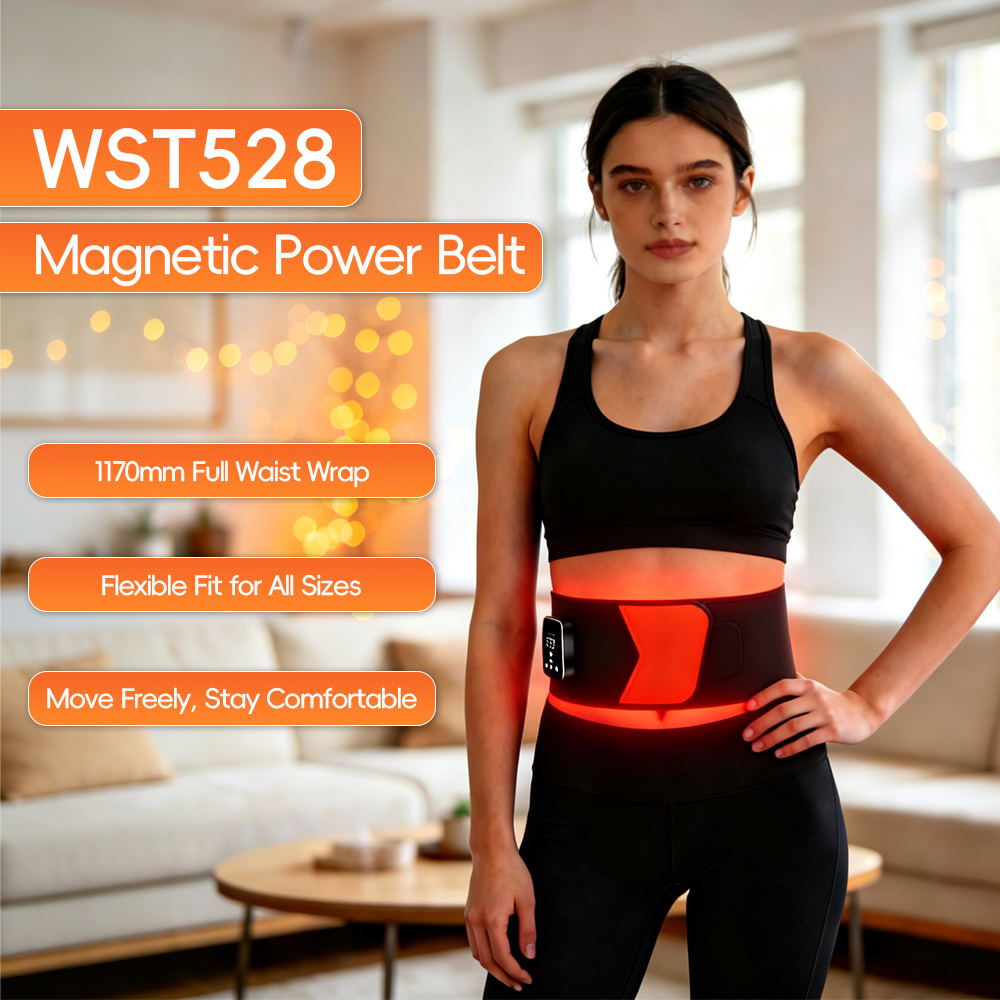
A targeted belt array with **105 LEDs** (5050 triple-chip diodes) distributes light across a **1170 × 176 mm** surface area. At a power density of **34–65 mW/cm²**, this falls well within the effective range for home-use photobiomodulation, while the **10.5W total output** ensures the array is energy-efficient without excessive heat generation.
**Key Takeaway:** The issue with most home light therapy is not the light itself—it is the impracticality of the delivery system. A wearable belt format solves the adherence problem.
---
## The Dosage-Safety Connection
However, effectiveness is not universal—it is dose-dependent and format-dependent.
**A pivotal usability analysis reveals:**
- **High-dose clinical panels (≥100 J/cm²):** Require precise timing, professional supervision, and stationary positioning. Overuse can lead to temporary thermal discomfort.
- **Consumer-grade wearable belt dosage:** Operating at **34–65 mW/cm²** with adjustable session timers (5–30 minutes) delivers a controlled energy dose—typically **10–30 J/cm² per session**—well within the optimal home-use window.
- **Scientific Consensus:** Within standard at-home parameters, a belt-format device supports consistent application to the torso and waist without the setup friction of clinic-style hardware.
---
## Your 3-Step Safe Integration Protocol
Based on ergonomic and photobiomodulation best practices, here is the "Progressive Comfort Protocol" for integrating a red light belt into your routine:
### Step 1: Spectral Selection – The "Dual-Wavelength" Strategy
**Product Feature:** The **WST528 Red Light Therapy Belt** utilizes pure **660nm red + 850nm near-infrared wavelengths** in a **1:2 ratio**—zero blue light emission, zero UV.
**Why It Matters:** By focusing on the red and near-infrared spectrum associated with tissue-level support and deeper penetration, the device targets the waist, back, and abdominal areas without the surface-level pigmentation risks linked to shorter wavelengths like blue or UV.
**User Action:** Verify your device emits **630–850nm only**. Avoid "full spectrum" or white-light devices if your goal is targeted red and near-infrared exposure for the torso.
### Step 2: Gradual Integration – From Posture Check to Routine
Following wearable therapy methodologies, we recommend:
| Phase | Duration | Protocol | Observation Point |
|---|---|---|---|
| Fit Test | Week 1 | Wear loosely over a thin layer of clothing; 10 min/session, 2×/week | Comfort of fit, skin response to contact |
| Low-Frequency Adaptation | Weeks 2–3 | Direct skin or thin fabric contact; 15 min/session, 3×/week | Overall sense of lumbar ease, post-session comfort |
| Maintenance Routine | Week 4+ | 20 min/session, 3–4×/week; explore pulse modes | Consistency of use, integration into daily schedule |
**Product Feature:** The **WST528** includes a **magnetic 5000mAh battery controller** with **3-tier intensity control** (P1: 33% / P2: 66% / P3: 90%), **3 pulse-frequency modes** (constant, 10Hz slow pulse, 40Hz fast pulse), and **6-level auto timers** (5–30 minutes), allowing beginners to start at the lowest irradiance level and build tolerance progressively.
### Step 3: Eliminate Confounding Variables – The "Consistency Rule"
The most common reason users abandon light therapy is not adverse effects—it is inconvenience.
**During Your First 4 Weeks:**
✅ **Establish:** A fixed time slot (e.g., immediately after work or post-workout)
✅ **Amplify:** Hydration, ergonomic chair setup, gentle mobility work for the lumbar region
✅ **Monitor:** Session consistency rather than immediate sensation; photobiomodulation benefits are cumulative
✅ **Leverage:** The cordless design—charge via USB and use while reading, working, or recovering on the sofa
**Keywords:** red light therapy belt, LED therapy wrap for back, infrared light belt for waist, wearable red light device, home light therapy routine, portable red light therapy, 660nm 850nm therapy belt, red light therapy for muscle recovery, cordless light therapy belt, at-home wellness device
---
## FAQ Schema: Addressing Search Queries Directly
**Q: Can I use a red light belt if I have sensitive skin on my back or waist?**
A: The 660nm and 850nm wavelengths used in the WST528 are non-ionizing and generally well-tolerated. Start with the lowest intensity (P1, 33% output) over a thin layer of clothing for the first week. If any persistent irritation occurs, discontinue use and consult a dermatologist.
**Q: Is the heat from the belt normal?**
A: Mild warmth is expected due to LED operation and near-infrared absorption. The WST528 operates at **5V output** with no active cooling fan required. If warmth becomes uncomfortable, reduce the intensity level or increase fabric thickness between the device and skin.
**Q: How is a belt better than a panel for my lower back?**
A: A belt maintains consistent contact and distance across the curved anatomy of the waist and lumbar region, while leaving your hands free. The **1170 × 176 mm** flexible form factor conforms to the body—something rigid panels cannot achieve without precise positioning.
**Q: Can I move around while wearing it?**
A: Yes. The **cordless magnetic battery controller** (88 × 69 × 25.7 mm, ABS matte finish) attaches securely and provides **5000mAh** capacity. The belt can be worn during light activity such as reading, desk work, or relaxation.
**Q: What is the difference between constant mode and pulse mode?**
A: Constant mode delivers uninterrupted light output. Pulse modes (10Hz and 40Hz) alternate the LED output in rapid cycles. Some users prefer pulsed modes for longer sessions; others prefer constant mode for steady exposure. The WST528 allows you to toggle between all three.
**Q: Will this help with body contouring or weight loss?**
A: Red light therapy is not a weight-loss device. The WST528 is designed to support surface-level skin appearance and general wellness comfort in the targeted area through photobiomodulation. It does not treat, cure, or diagnose any condition.
---
## Conclusion: Convenience Over Compromise
To return to the original forum concern: *"Is there a practical way to do red light therapy on my back and waist at home?"*
The evidence-based answer: When utilizing the correct dual-wavelength format (660nm red + 850nm NIR) in a wearable, cordless design with controlled dosage and flexible timing, red light therapy becomes a sustainable part of your daily routine—not a clinic appointment you have to schedule.
**The WST528 Red Light Therapy Belt** is engineered for real-life usability:
✅ **Dual-Wavelength Array** – 105 LEDs at 660nm + 850nm for surface-to-deep coverage
✅ **Cordless Freedom** – 5000mAh magnetic battery; no tether to a wall outlet
✅ **Dosage-Controlled Sessions** – 3 intensity levels + 6 timer settings (5–30 min)
✅ **Flexible Full-Torso Fit** – 1170mm wearable wrap conforms to waist, back, and abdomen
✅ **Pulse + Constant Modes** – 10Hz / 40Hz / steady output for personalized preference
Stop letting "setup friction" block your recovery routine. Begin your evidence-based light therapy journey today → **[Shop Now]**
---
Disclaimer:
The WST528 Red Light Therapy Belt is a general wellness and personal care device. It is not intended to diagnose, treat, cure, or prevent any disease or medical condition. The information provided in this article is for educational and marketing purposes only and does not constitute medical advice. Individual results may vary. If you are pregnant, have a pre-existing medical condition, photosensitive skin, or are undergoing treatment for any health issue, consult a qualified healthcare professional before using this or any light therapy device. Discontinue use immediately if you experience adverse reactions. This device has not been evaluated by the FDA.


