
Views: 0 Author: Site Editor Publish Time: 2026-08-03 Origin: Site
Navigating the market for light devices often feels overwhelming. Buyers constantly face inflated power specifications and confusing wattage claims. Manufacturers frequently use these numbers to obscure the true capability of the device. The critical factor for success lies in the relationship between actual light intensity and proximity to your body.
Measuring power directly at the surface tells you little about real-world effectiveness. A high-quality device must deliver a clinically relevant, uniform dose of light. You need this energy at a practical treatment distance, not just peak power at the source. Understanding the core concept of red light panel irradiance distance will fundamentally change how you evaluate these tools.
You will learn how the physics of light drop-off affects your daily sessions. We will explore how lens angles shape photon delivery. You will also see why precise dosing dictates your physical results. Let us help you evaluate these critical design choices to maximize your daily therapy routine.
Surface metrics are misleading: Irradiance drops exponentially as you move away from the light source due to the Inverse Square Law; panels must be evaluated at 6-to-12-inch distances.
Lens design drives efficiency: Premium panels utilize specific LED beam angles (e.g., 30° to 60°) to project light forward, minimizing dispersion and reducing treatment times.
Dose dictates outcomes: Accurate dosing (measured in Joules/cm²) requires calculating verified irradiance at your specific treatment distance.
Goal-specific positioning: Deep tissue recovery requires closer proximity and higher irradiance, while skin and superficial treatments benefit from greater distance and wider coverage.
Many buyers confuse electrical power consumption and actual light output. You plug a device into the wall, and it draws a certain amount of electricity. This is wattage. However, wattage does not measure the therapeutic light reaching your skin. We measure the actual photonic energy delivered to your body as irradiance. Engineers express this metric in milliwatts per square centimeter (mW/cm²).
Understanding the physics of light drop-off helps you avoid common buyer traps. Light behaves according to the Inverse Square Law. As light travels away from its source, it spreads out and loses intensity rapidly. If you double your distance from the light source, the intensity drops drastically. It does not just halve; it scatters over a much wider area. You must account for this physical reality when planning your daily sessions.
Budget manufacturers often exploit this law. They artificially inflate their specifications by reporting irradiance at zero inches. Measuring light directly on the LED chip produces massive numbers. This "surface measurement" is a major red flag in the industry. Nobody presses their bare skin against a hot LED grid for twenty minutes. Direct contact causes uncomfortable hot spots and uneven coverage. You need a device engineered to project usable energy across a gap.
We highly recommend evaluating devices based on realistic scenarios. Always look for irradiance numbers measured at six or twelve inches. This metric gives you a truthful picture of the device's optical power. It shows you exactly how much energy hits your skin when you stand comfortably away from the unit.
The gap between the LED and your body requires specific engineering. High-quality manufacturers use secondary optics to solve the distance problem. Bare LEDs emit light in a very wide arc, often over 120 degrees. This wide spread causes energy to scatter off into the room. Secondary lenses sit directly over the bare LEDs. They gather the scattering photons and focus them forward toward your body.
The choice of beam angle drastically alters the user experience. Narrow lenses, typically around 30 degrees, function like spotlights. They drive intense light deeper into tissues over longer distances. Wide lenses, ranging from 60 to 90 degrees, act more like floodlights. They provide broader, softer coverage across a larger surface area.
Premium panel design expertly balances these optical angles. Engineers design the lens array to create an overlapping grid of light. This overlap ensures uniform energy distribution across your skin. A properly engineered Full-Spectrum LED Therapy Panel delivers an even blend of targeted wavelengths. You receive a consistent mix of red and near-infrared light without experiencing dead zones at a six-inch distance.
Poor lens design leads to uneven sessions. You might get intense energy directly in front of one LED but almost nothing an inch away. Secondary optics eliminate this problem. They blend the different wavelengths into a smooth, homogeneous field of light. This ensures your cells receive a balanced therapeutic dose regardless of slight body movements.
Knowing your irradiance is only half the battle. You must calculate your total dose to achieve clinical results. The scientific community measures this dose in Joules per square centimeter (J/cm²). The standard dosing equation is straightforward. You multiply your irradiance (mW/cm²) by your session time (seconds). Then, you divide by 1,000 to find your total dose.
Your distance from the device directly dictates your session time. If you move from 6 inches to 12 inches away, the irradiance drops. You must increase your session time proportionally to hit the same Joule target. Standing further back means you must wait longer for the energy to accumulate in your tissues.
Implementation reality often surprises new users. Choosing a device with poor light projection creates unfeasibly long treatment times. If a budget device only delivers 15 mW/cm² at 12 inches, reaching a therapeutic 40 Joules takes over 40 minutes per area. Most people abandon their routines if sessions take this long. High irradiance at your chosen distance keeps sessions comfortably under 15 minutes.
| Treatment Distance | Example Irradiance (mW/cm²) | Time Needed for 30 Joules | Coverage Area |
|---|---|---|---|
| Surface (0 inches) | 100+ (Misleading) | Not recommended | Minimal (Hot spots) |
| 6 Inches | 65 mW/cm² | Approx. 7.5 Minutes | Targeted/Moderate |
| 12 Inches | 40 mW/cm² | Approx. 12.5 Minutes | Broad/Full Torso |
| 18 Inches | 25 mW/cm² | Approx. 20 Minutes | Maximum width |
You can use the table above as a baseline. It illustrates how time requirements escalate as you step backward. A well-engineered device prevents this extreme time inflation. It pushes adequate photon density across the gap, preserving your daily schedule.
Establishing a strict baseline helps you shortlist the best devices. You must demand transparent data from the manufacturer. Refuse to accept single-number claims. A trustworthy company provides a clear chart showing irradiance at 6, 12, and 18 inches. This standardized metric proves the device can project energy effectively.
Third-party diagnostic testing separates premium devices from budget knock-offs. The testing equipment matters immensely. Many cheap brands use inexpensive solar meters to test their products. Solar meters notoriously overstate irradiance, especially in the near-infrared spectrum. They capture heat and ambient light, drastically inflating the numbers. You should only trust reports generated by independent, laboratory-grade spectrometers. When evaluating a RED Therapy Panel, verify they publish these independent spectrometer reports on their website.
Safety considerations extend beyond light intensity. You must factor in flicker rates and EMF compliance. Budget electronics often produce an invisible strobe effect known as LED flicker. This invisible flashing strains the nervous system and causes headaches. A well-designed device features advanced power drivers. These drivers maintain high irradiance without exposing you to perceptible flicker.
Electromagnetic fields (EMFs) present another concern. You sit close to these devices for extended periods. Premium panels utilize shielded power cords and grounded internal components. This ensures zero detectable EMF emissions at your standard treatment distances. Always prioritize safety certifications alongside optical performance.
Irradiance charts measured at realistic distances (6 to 18 inches).
Independent spectrometer testing reports from certified labs.
Secondary lens optics (typically 30 to 60-degree beam angles).
Zero detectable EMF at 6 inches.
Peak irradiance measured strictly at 0 inches or the surface.
Testing data derived from handheld solar meters.
Bare LEDs without focusing lenses.
High flicker rates resulting from cheap power drivers.
Different wellness goals require completely different positioning strategies. You cannot use a single distance for every physical issue. Your skin needs a different dose than your joints. Understanding this distinction helps you unlock the full potential of your device.
Dermatological protocols focus on the superficial layers of the skin. You want to stimulate collagen, reduce redness, and improve tone. Skin cells require a surprisingly low dose of energy to respond positively. Too much energy can actually diminish returns. For superficial treatments, position yourself 12 to 18 inches away from the unit. This distance lowers the total irradiance. It delivers a gentle, broad dose ideal for facial rejuvenation.
Musculoskeletal protocols demand deeper tissue penetration. You want to reach muscles, ligaments, and joints. These dense tissues absorb a lot of light before the energy reaches the core. Position yourself much closer for deep tissue recovery. A distance of 4 to 6 inches maximizes near-infrared penetration. The higher irradiance pushes past the skin barrier to trigger cellular repair in the muscles.
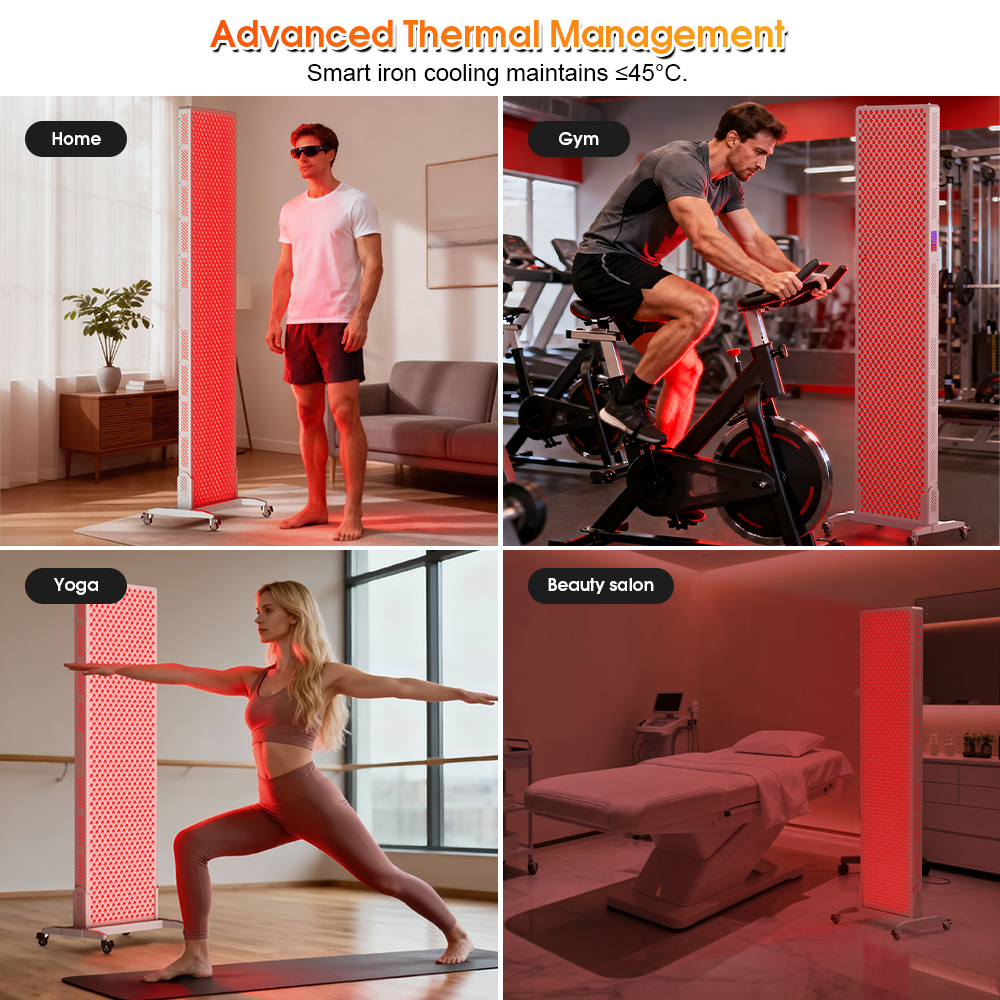
Scalability becomes crucial for comprehensive routines. Upgrading to a larger unit alters your distance strategy. Full-body devices allow you to maintain an optimal distance while treating a massive surface area simultaneously. You do not have to move a small device around your body for an hour. Treating your entire torso and legs at once improves daily adoption rates. Larger devices ensure you stick to your routine consistently.
Identify your primary goal for the session (skin health vs. muscle recovery).
Consult your device's irradiance chart to find the power output at various distances.
Position the unit 12-18 inches away for skin, or 4-6 inches away for deep tissue.
Calculate your target time using the Irradiance × Time = Joules formula.
Set a timer and maintain a consistent distance throughout the session.
Navigating the light therapy market requires looking past superficial marketing metrics. You must evaluate panels based on verified irradiance measured at practical distances. Surface-level power measurements tell you nothing about how the device performs in reality. The interplay between lens angles, physical distance, and light drop-off determines your clinical success.
We recommend mapping out your primary use case before making a purchase. Decide if you need deep muscle penetration or superficial skin care. This decision dictates the necessary beam angle and optimal device size. Always request third-party spectrometer reports to verify the power claims. Taking these steps ensures you invest in a tool capable of delivering precise, effective doses for years to come.
A: Irradiance decreases exponentially as distance increases, governed by the Inverse Square Law. Moving from 6 inches to 12 inches away can reduce the light intensity hitting your skin by 30% to 50%, depending on the specific lens angles used by the manufacturer.
A: No. Extremely high irradiance can lead to over-dosing, which triggers a biphasic response where therapeutic benefits actually decrease. High irradiance is only useful if it projects smoothly across a comfortable treatment distance without creating skin hot spots.
A: First, find the verified irradiance (mW/cm²) at your exact distance. Multiply that number by your session time in seconds. Divide the final result by 1,000. For example: 50 mW/cm² × 600 seconds = 30,000. Divided by 1,000 equals a dose of 30 Joules/cm².
A: Discrepancies usually stem from testing methods. Budget brands often measure at 0 inches using cheap solar meters that capture heat, inflating the score. Premium brands provide transparent data measured at 6 or 12 inches using highly accurate laboratory spectrometers.


